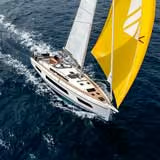
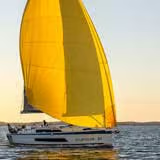
According to Wikipedia, a jib is a triangular sail that sets ahead of the foremast of a sailing vessel, with its forward corner (tack) fixed to the bowsprit, bow, or deck. On modern bermudan-rigged sloops, the term "jib" specifically refers to a headsail whose clew does not overlap the mast significantly, or remains entirely within the foretriangle.
Sailmakers classify headsails using the Luff Perpendicular (LP) measurement—the perpendicular line drawn from the clew to the luff. A standard working jib typically has an LP of 100% or less of the J-dimension (the foredeck distance from the mast to the forestay). In contrast, a genoa features a larger LP ranging between 110% and 150%, overlapping the mainsail considerably. On cutter-rigged vessels with multiple headsails, the forward-most sail is the jib (or flying jib), while the inner sail is the staysail.
In practical sailing, the jib creates a high-velocity airflow slot between itself and the mainsail, dramatically increasing lift on upwind points of sail. Efficient crew coordination requires proper yacht rope handling to adjust jib sheets and fairlead tracks. During maneuvers such as tacking and gybing, releasing and backing the jib sheet at the correct instant ensures smooth turns. Note that in non-maritime contexts, "jib" refers to the operating arm of a mechanical crane or a camera boom.
Quick answers
What is Jib?
A triangular headsail set forward of the mast along the forestay, providing primary aerodynamic drive and steering balance.
What is Jib used for on a yacht?
Used for headsails with LP <= 100%. Do not confuse with the mechanical jib arm of a crane or camera rig.
What topics are related to Jib?
Sail Handling & Trim, Boom, Boom vang (Kicking strap), Genoa sail
Sources and verification
- Navi.training: GPS, AIS та радар. - «Три ока» вашої яхти – чи знаєте ви різницю?
- Navi.training: Работа с веревками на яхте: лебедки и блоки для чайников
- Navi.training: Робота з мотузками на яхті: лебідки та блоки для початківців
- Navi.training: Основні вітрильні маневри для новачків: оверштаг та фордевінд простими словами
- Navi.training: Yacht Rope Handling: Winches and Blocks for Beginners
- Navi.training: Essential Sailing Maneuvers for Beginners: Tacking and Gybing in Simple Terms
- Wikipedia: Jib · CC BY-SA 4.0 / GFDL

 22 min to read