Alex Burlakov  27 min to read

THE SEA HAS A LANGUAGE OF ITS OWN
Clear explanations of sailing and maritime terminology, grounded in professional sources and practical seamanship.
46.1603° N · 1.1511° WNAVI.TRAINING
navigation
The Automatic Identification System (AIS) is an automated tracking system that transmits vessel identity, position, course, and speed via VHF radio frequencies to nearby ships and shore stations for collision avoidance.
sailing
The chain connecting the anchor to the vessel, part of the ground tackle.
sailing
The ratio of the length of anchor rode (chain and/or rope) paid out to the vertical distance from the bow roller to the seabed.
sailing
A heavy device dropped to the seabed or streamed in open water to hold a vessel in place by mechanical grip or hydrodynamic drag.
navigation
The speed and direction of the wind observed relative to a moving vessel, formed by the vector sum of the true wind velocity and the headwind caused by the boat's movement.
boatbuilding
In yachting: weight placed low in a vessel, often in the keel, to lower the centre of gravity and increase stability. It can be fixed (lead, iron) or water ballast in tanks.
sailing
A point of sail where the boat travels at approximately 90° relative to the true wind direction, perpendicular to its centerline.
boatbuilding
The maximum width of a vessel’s hull, measured at the widest point excluding appendages.
navigation
The horizontal angle measured clockwise from a reference north meridian to the line of sight toward an object, expressed from 000° to 360°.
sailing
A versatile nautical term denoting a designated space for mooring a vessel, a sleeping accommodation aboard, or a safe navigational distance from hazards.
sailing
A running rigging component that applies downward force on the boom to control mainsail leech tension and shape.
sailing
A horizontal spar attached to the mast at its forward end, used to extend and control the foot of a fore-and-aft main sail.
boom ~
boatbuilding
The forwardmost part of a ship or yacht's hull, designed to slice through water and provide reserve buoyancy.
sailing
A broad reach is a point of sail relative to the wind where the true wind blows onto the vessel from behind the beam, angled between 110° and 160° from the bow.
navigation
A system of floating and fixed aids to navigation used to indicate channels, navigational hazards, safe water, and special areas.
boatbuilding
A cabin is an enclosed space on a yacht or ship used for accommodation, sleeping, or work by crew and passengers.
navigation
A navigational mark indicating the safe side of a hazard relative to the cardinal compass points.
sailing
A multihull vessel featuring two parallel hulls of equal size joined by a connecting bridge or deck structure, deriving its initial stability from hull beam width rather than a ballast keel.
sailing
A T-shaped deck fitting with two opposing horns used to secure mooring lines, halyards, and sheets.
sailing
The point of sail closest to the wind (typically 30°–45° to the apparent wind), where sails are sheeted in tightly to generate aerodynamic lift.
boatbuilding
An open or partially enclosed area on the deck of a yacht where the controls are located and the crew operates.
safety
The International Regulations for Preventing Collisions at Sea (COLREGs) are the global IMO-mandated rules establishing navigation standards, right-of-way, and signaling for vessels at sea.
navigation
Course is the horizontal direction in which a vessel is steered or intended to be steered, measured as an angle in degrees from 000° clockwise to 360° relative to a reference meridian.
boatbuilding
A deck is a permanent covering over a compartment or the hull of a vessel, serving as a floor for crew, passengers, and gear, while also contributing to the longitudinal and transverse strength of the structure.
navigation
An electronic acoustic instrument that measures water depth underneath a vessel's hull by calculating the travel time of ultrasonic sound pulses reflected from the seabed.
boatbuilding
Displacement is the weight or volume of water displaced by a floating vessel, equal to the total mass of the yacht according to Archimedes' principle.
boatbuilding
The vertical distance between the waterline and the lowest point of a vessel's hull, keel, or rudder.
safety
An EPIRB is a vessel-registered emergency transmitter designed to broadcast distress signals on 406 MHz to rescue authorities via the Cospas-Sarsat satellite system.
sailing
A resilient bumper device (typically air-filled PVC, polyurethane elastomer, or foam) deployed along a vessel's hull to absorb kinetic energy and prevent damage during mooring or ship-to-ship berthing.
boatbuilding
Freeboard is the vertical distance measured from the waterline to the upper deck level at the lowest point where water can enter the vessel.
sailing
A genoa sail is a large overlapping headsail whose clew extends aft past the mast line.
navigation
A satellite-based radionavigation system providing precise geographic coordinates, speed over ground, and course over ground for vessels worldwide.
sailing
A gybe (also spelled jibe) is a sailing maneuver in which the stern of a vessel passes through the wind line, shifting the mainsail and boom from one side of the boat to the other while sailing downwind.
sailing
A line of running rigging used to hoist a sail, yard, flag, or ladder up a mast or stay.
navigation
Heading is the direction in which the longitudinal axis (bow) of a vessel is pointed at any given moment, measured in degrees from 000° to 359° clockwise from North.
safety
A seamanship maneuver where sails and rudder are set in opposition to bring a sailing vessel to a relative stop and controlled drift.
heave-to
boatbuilding
The watertight structural shell of a vessel that provides buoyancy, stability, and structural integrity under hydrodynamic and aerodynamic loads.
sailing
A triangular headsail set forward of the mast along the forestay, providing primary aerodynamic drive and steering balance.
boatbuilding
The central longitudinal structural element at the bottom of a hull, or a weighted underwater fin that provides stability and resists lateral leeway on modern sailing vessels.
navigation
A nautical unit of speed equal to one nautical mile per hour (exactly 1.852 km/h or approximately 0.514 m/s).
navigation
A sea mark used in the IALA Maritime Buoyage System to indicate the port or starboard edge of a channel relative to the direction of buoyage.
navigation
Geographical latitude is the angular distance of a location north or south of the Earth's equator, expressed in degrees from 0° at the equator to 90° at the poles.
sailing
The aft (trailing) edge of a triangular sail, running between the head and the clew.
sailing
The direction downwind from a reference point, or the side of a vessel sheltered from the wind.
safety
A personal flotation device designed to keep an unconscious person's head above water with airway clear.
safety
A self-inflating collective lifesaving appliance designed to keep survivors afloat and protected from exposure after abandoning a vessel.
navigation
Geographic longitude is the angular distance measured east or west from the Prime Meridian (Greenwich) to the meridian of a given point, ranging from 0° to 180° E or W.
sailing
The leading edge of a sail, extending from head to tack, and the action of turning the bow of a sailboat into the wind.
navigation
A self-contained navigation instrument that utilizes Earth's magnetic field to indicate vessel heading and bearings.
sailing
A mainsail is the primary sail rigged on and behind the main mast of a fore-and-aft rigged sailing vessel.
safety
An emergency situation where a crew member or passenger falls off a vessel into the water, as well as the standard emergency shout and recovery maneuver.
navigation
An active radio detection system emitting microwave pulses to measure range and bearing to targets for collision avoidance and navigation in poor visibility.
sailing
A tall vertical spar or extruded profile erected along the centerline of a vessel to support sails, standing rigging, and navigational hardware.
radio
The international standard radiotelephone distress signal transmitted over VHF/HF radio to indicate grave and imminent danger to a vessel or human life.
sailing
A monohull is a vessel featuring a single hull structure, relying on a weighted ballast keel to provide righting moment and transverse stability under sail.
sailing
A high-elasticity synthetic rope used to secure a vessel to a quay, pier, mooring buoy, or alongside another vessel.
navigation
A graphic representation of a maritime area and adjacent coastal regions, providing detailed information on water depths, hazards, channels, and aids to navigation.
navigation
A unit of distance used in marine and air navigation, defined internationally as exactly 1,852 meters.
sailing
A control line in the running rigging of a sailboat that attaches the mainsail clew to the boom and adjusts the tension along the foot of the sail.
radio
The international radiotelephone urgency signal, broadcast three times ("PAN-PAN, PAN-PAN, PAN-PAN") on VHF Channel 16 to indicate an urgent situation concerning the safety of a vessel or person without immediate grave danger.
sailing
A nautical term denoting the left side of a vessel when facing forward towards the bow, a sailing vessel's wind orientation (port tack), or a harbor facility.
sailing
An underwater hydrodynamic blade forming part of a vessel's steering system, used to control or alter the yacht's heading by deflecting water flow.
sailing
A point of sail where a vessel travels in the same direction as the true wind, at an angle of approximately 180° (typically between 170° and 190°).
sailing
The bottom edge of a sail, running between the tack and clew.
sailing
The practice of reducing a sail's active surface area to maintain vessel stability, reduce heel, and preserve control in strong winds.
sailing
A mechanical deck device featuring a rotating drum, internal gear assembly, and ratchet mechanism used to multiply human force when tensioning sheets, halyards, and control lines.
safety
A heavy-weather drag device deployed from the bow of a vessel to hold its head into the wind and waves, significantly reducing downwind drift.
sailing
A running rigging line used to trim a sail by controlling its angle relative to the wind and its tension.
sailing
A shroud is a cable or rod forming part of a sailing vessel's standing rigging, providing lateral support to the mast and transferring wind loads to the hull.
sailing
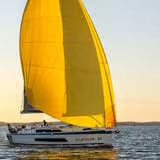
A spinnaker is a large, lightweight sail designed specifically for downwind sailing on courses from a reach to a run (wind angles 90°–180°).
sailing
Starboard is the right side of a vessel when facing forward toward the bow, identified at night by a green navigation sidelight.
sailing
A fore-and-aft standing rigging cable or rod that supports a sailboat's mast against longitudinal loads.
boatbuilding
The stern is the rear or aft-most section of a vessel's hull, directly opposing the bow and housing steering gear, transom structures, and navigation lights.
navigation
A tack defines both the orientation of a sailing vessel relative to the wind (port tack or starboard tack) and the maneuver of turning the bow through the wind eye to change sides.
sailing
A lightweight strip of yarn or tape (6–8 in / 15–20 cm) attached to a sail to visually indicate airflow and guide precise sail trim.
boatbuilding
Transom — the flat or curved transverse surface forming the stern of a vessel, used for mounting engines, rudders, and other equipment.
sailing
A traveller is a car that slides along a transverse track, to which the mainsheet block is attached, allowing the sheet's attachment point to be adjusted athwartships to control sail shape.
meteorology
True wind is the speed and direction of the airflow over the water surface relative to a stationary observer or land, unaffected by the motion of the vessel.
radio
A VHF marine radio is a combined transmitter and receiver operating in the VHF maritime mobile band (156–174 MHz), used worldwide for vessel safety, inter-ship communication, and navigation control.
boatbuilding
The waterline is the intersection of the surface of the water with the hull of a vessel, varying with load.
navigation
A specific geographic location defined by coordinates (latitude and longitude) used in marine electronic navigation to delineate routes, turning points, or hazards.
sailing
The direction from which the wind is blowing, or the side of a vessel facing into the wind.
sailing
A purpose-built, sheltered harbor designed to provide secure berthing, infrastructure, utilities, and maintenance services for recreational vessels and yachts.