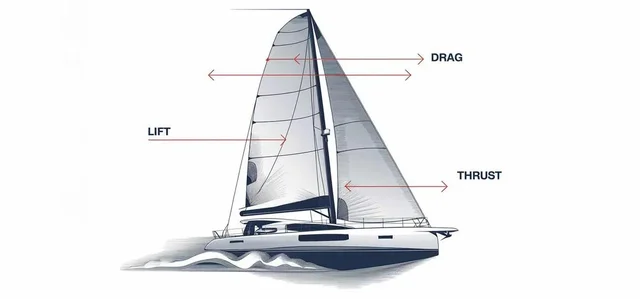
The luff is the forward edge of a sail, running from the head to the tack. In Bermuda-rigged boats it is often attached to the mast via slides or a bolt rope. The term ‘luff’ also describes the maneuver of steering the bow into the wind, causing the sail to flutter. Distinguishing between the physical edge and the maneuver is fundamental. Luff tension is a primary sail trim control: it determines the draft position and overall shape. Tension is adjusted with the halyard and, for finer control, a cunningham downhaul, which leads through a cringle in the luff just above the tack. According to Wikipedia, Briggs Cunningham invented this gear for swift racing adjustments. Increasing luff tension pulls the draft forward and flattens the sail—ideal for strong winds; easing it moves draft aft for light air. Watching the telltales along the luff helps the crew detect optimal trim and avoid flow separation. Understanding how the luff interacts with airflow is crucial; our article on how a sail works explains the aerodynamics, and mastering tacking and gybing helps avoid unintentional luffing. Proper luff control ensures efficient, safe sailing.
Quick answers
What is Luff?
The leading edge of a sail, extending from head to tack, and the action of turning the bow of a sailboat into the wind.
What is Luff used for on a yacht?
In casual sailing speech, ‘luff’ may refer to the sail edge or the act of luffing. Context clarifies meaning. Specify ‘luff of the sail’ for the edge and ‘luff up’ for the maneuver.
What topics are related to Luff?
Sail Handling & Trim, Boom, Boom vang (Kicking strap), Genoa sail
Sources and verification
- Navi.training: Работа с веревками на яхте: лебедки и блоки для чайников
- Navi.training: Основные парусные маневры для новичков: оверштаг и фордевинд простыми словами
- Navi.training: Скорость катамарана: миф или реальность для круизных катамаранов?
- Navi.training: Робота з мотузками на яхті: лебідки та блоки для початківців
- Navi.training: Основні вітрильні маневри для новачків: оверштаг та фордевінд простими словами
- Navi.training: Швидкість катамарана: міф чи реальність для круїзних катамаранів?
- Navi.training: Essential Sailing Maneuvers for Beginners: Tacking and Gybing in Simple Terms
- Navi.training: How a sail works on a yacht: classic and modern explanation
- Navi.training: Yacht Rope Handling: Winches and Blocks for Beginners
- Wikipedia: Cunningham (sailing) · CC BY-SA 4.0 / GFDL

 14 min to read