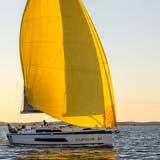
In nautical navigation, a vessel's course is the angle between a north reference meridian and the longitudinal center line of the craft pointing forward. It is measured in degrees from 000° clockwise through 360°. Navigators strictly distinguish nautical course angles from points of sail (such as close-hauled, beam reach, or broad reach) and from educational training courses.
Depending on the north reference used, navigation defines three distinct types of course: 1. True Course (TC): The angle relative to True North (geographic meridian). 2. Magnetic Course (MC): The angle relative to Magnetic North, accounting for magnetic variation. 3. Compass Course (CC): The direct reading from the ship's steering compass, requiring corrections for both variation and magnetic deviation.
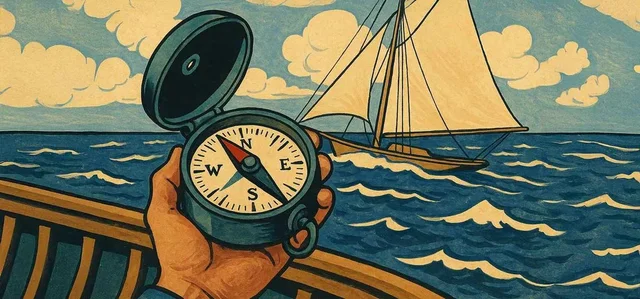
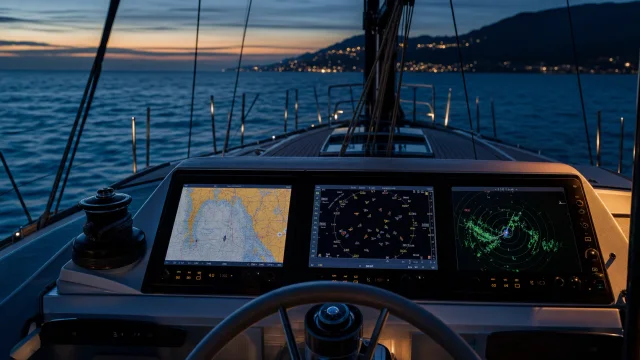
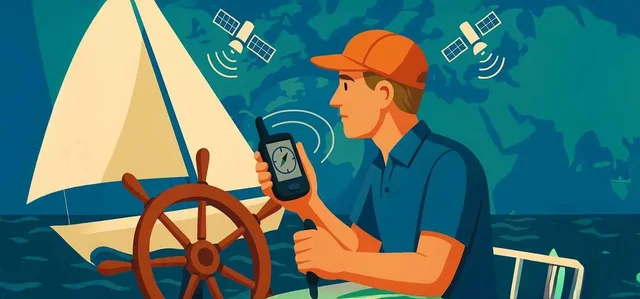
Wind leeway and tidal currents often cause a vessel to drift away from its steered course. The actual trajectory over the seabed is called the Course Over Ground (COG). While traditional plotting requires accounting for drift, modern skippers monitor COG directly using marine GPS navigation devices. However, safe passage planning still relies on cross-checking satellite data against a calibrated marine steering compass. As noted in reference literature, maintaining a precise course forms the core of dead reckoning and coastal navigation.
Quick answers
What is Course?
Course is the horizontal direction in which a vessel is steered or intended to be steered, measured as an angle in degrees from 000° clockwise to 360° relative to a reference meridian.
What is Course used for on a yacht?
Always record courses using three digits (e.g., 005° instead of 5°) to prevent misinterpretation in logbooks and VHF communications.
What topics are related to Course?
Sources and verification
- Navi.training: GPS, AIS та радар. - «Три ока» вашої яхти – чи знаєте ви різницю?
- Navi.training: Как работает GPS, и роль электронной навигации в мире яхтинга
- Navi.training: Як працює GPS та роль електронної навігації у світі яхтингу
- Navi.training: Компас на яхті: Як користуватися морським компасом і для чого він потрібен яхтсменам?
- Navi.training: How GPS Works and the Role of Electronic Navigation in the World of Sailing
- Navi.training: The Compass on a Sailboat: How to Use a Marine Compass and Why Sailors Need It
- Wikipedia: Sailing · CC BY-SA 4.0 / GFDL
 21 min to read