In marine navigation, a bearing is the horizontal angle measured clockwise from a reference north direction to the line of sight toward a specific object or landmark, expressed in degrees from 000° to 360°. It must not be confused with vessel heading or course, which describe the direction the vessel itself is moving. Outside of navigation, the English homonym "bearing" denotes a mechanical machine element (such as a ball bearing); in nautical contexts, it strictly refers to directional angular measurements.
Bearings are classified according to the reference meridian used. True Bearing (TB) uses True Geographic North. Magnetic Bearing (MB) references Magnetic North and incorporates magnetic variation. Compass Bearing (CB) is read directly from a marine compass on a sailboat and must be corrected for both magnetic variation and compass deviation. Relative Bearing (RB) measures the angle clockwise from the vessel's bow (000° to 360°).
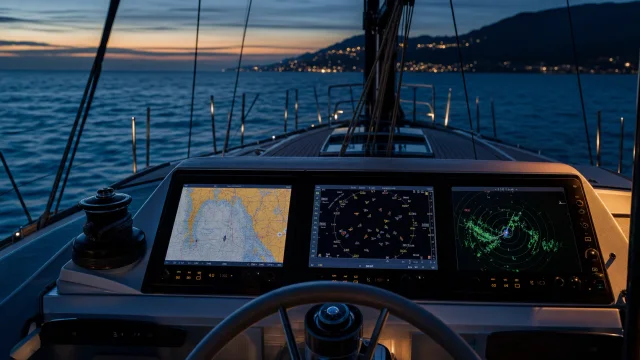
Courses of constant bearing, known as rhumb lines, were mapped as straight lines on Gerardus Mercator’s 1569 world map, revolutionizing chart work for mariners. In seamanship, taking frequent bearings is critical for collision avoidance: a constant bearing with a decreasing distance indicates a risk of collision. Sailors routinely combine visual hand-bearing compass readings with electronic positioning data obtained from GPS and electronic navigation devices to fix their position on nautical charts accurately.
Quick answers
What is Bearing?
The horizontal angle measured clockwise from a reference north meridian to the line of sight toward an object, expressed from 000° to 360°.
What is Bearing used for on a yacht?
Always log the time and vessel heading when taking a bearing. Remember: a constant bearing with decreasing range signals a danger of collision.
What topics are related to Bearing?
Sources and verification
- Navi.training: Компас на яхте: Как пользоваться морским компасом и для чего он нужен яхтсменам?
- Navi.training: GPS, AIS та радар. - «Три ока» вашої яхти – чи знаєте ви різницю?
- Navi.training: Компас на яхті: Як користуватися морським компасом і для чого він потрібен яхтсменам?
- Navi.training: Як працює GPS та роль електронної навігації у світі яхтингу
- Navi.training: How GPS Works and the Role of Electronic Navigation in the World of Sailing
- Navi.training: The Compass on a Sailboat: How to Use a Marine Compass and Why Sailors Need It
- Wikipedia: Mercator 1569 world map · CC BY-SA 4.0 / GFDL

 21 min to read