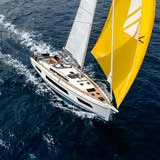
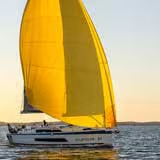
The leech is the aft edge of a triangular sail, connecting the head at the top of the mast to the clew at the end of the boom. Unlike the luff, the leech is not attached to any spar and is free to fly, often with a slight curve known as "roach." This roach is not a flaw but a crucial aerodynamic feature that adds sail area and improves efficiency, particularly when sailing upwind. Proper leech tension is a fundamental aspect of yacht rope handling, as it directly dictates the sail's shape and power. A leech that is too open will spill wind, depowering the sail, while a leech that is too closed, or "hooked," creates excessive drag and heeling. Control is achieved primarily through the mainsheet and boom vang. It is important to distinguish the mainsail leech from the leech of a jib, which is also called the leech but is adjusted using jib sheet fairleads. According to Wikipedia, the term is derived from the Old English word for the edge of a cloth. To master leech control in real conditions, it's essential to practice essential sailing maneuvers like tacking, where easing and trimming the leech correctly ensures a smooth and efficient turn through the wind.
Quick answers
What is Leech?
The aft (trailing) edge of a triangular sail, running between the head and the clew.
What is Leech used for on a yacht?
The term applies to both mainsails and headsails. In the context of the mainsail, sailors often refer to "tightening the leech" to increase its tension and power.
What topics are related to Leech?
Sail Handling & Trim, Boom, Boom vang (Kicking strap), Genoa sail
Sources and verification
- Navi.training: Работа с веревками на яхте: лебедки и блоки для чайников
- Navi.training: Основные парусные маневры для новичков: оверштаг и фордевинд простыми словами
- Navi.training: Скорость катамарана: миф или реальность для круизных катамаранов?
- Navi.training: Робота з мотузками на яхті: лебідки та блоки для початківців
- Navi.training: Основні вітрильні маневри для новачків: оверштаг та фордевінд простими словами
- Navi.training: Швидкість катамарана: міф чи реальність для круїзних катамаранів?
- Navi.training: Yacht Rope Handling: Winches and Blocks for Beginners
- Navi.training: Essential Sailing Maneuvers for Beginners: Tacking and Gybing in Simple Terms
- Navi.training: Catamaran Speed: Myth or Reality for Cruising Catamarans?
- Wikipedia: Glossary of nautical terms (A–L) · CC BY-SA 4.0 / GFDL

 22 min to read