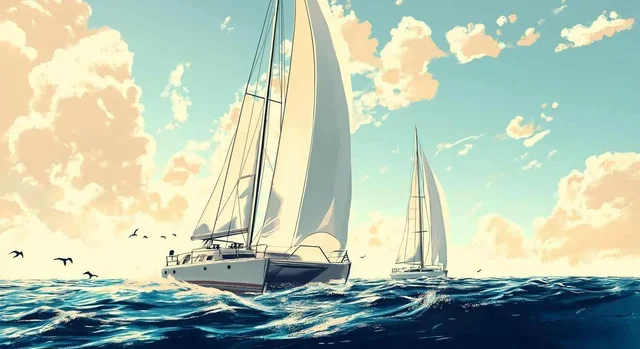
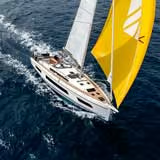
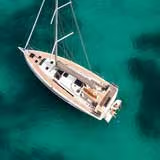
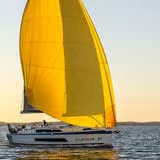
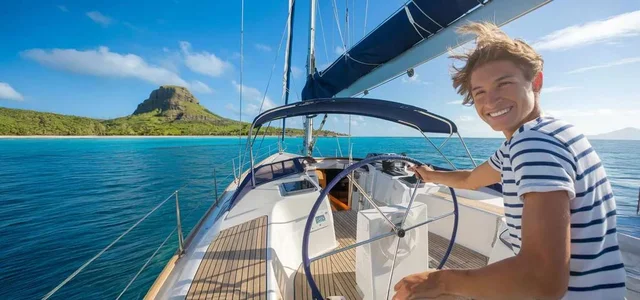
A monohull is the traditional configuration for sailing and motor vessels, characterized by a single continuous hull structure. Unlike multihulls such as catamarans, a sailing monohull achieves transverse stability through a heavily ballasted keel, which typically accounts for 30% to 45% of the boat's total displacement. As wind fills the sails, the vessel heels over—typically operating at heel angles between 15° and 25°—generating a righting moment that continuously pulls the hull back toward an upright position.
Standard cruising monohulls range in length overall (LOA) from 9 to 20 meters (30 to 65 feet), with a draft generally between 1.5 and 3.2 meters depending on the keel configuration. Mastering sail control on a monohull requires a firm understanding of basic yachting terminology, as well as trimming techniques to manage heel angle and helm balance. When evaluating options, sailors often compare the tight turning circle and sea-kindly motion of a catamaran or monohull for offshore passages.
According to Wikipedia reference data, high-performance monohull design reaches its peak in the IMOCA 60 class (18.3 meters or 60 feet LOA), governed by the International Monohull Open Class Association. Monohulls are uniquely capable of self-righting even after a 180-degree capsize, making them highly resilient for ocean sailing.
Quick answers
What is Monohull?
A monohull is a vessel featuring a single hull structure, relying on a weighted ballast keel to provide righting moment and transverse stability under sail.
What is Monohull used for on a yacht?
Monohull specifically denotes a single-hulled craft, contrasting with catamarans (double hull) and trimarans (triple hull).
What topics are related to Monohull?
Sources and verification
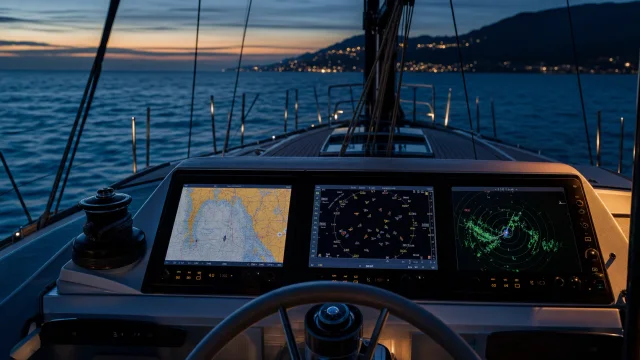
- Navi.training: GPS, AIS та радар. - «Три ока» вашої яхти – чи знаєте ви різницю?
- Navi.training: Работа с веревками на яхте: лебедки и блоки для чайников
- Navi.training: Робота з мотузками на яхті: лебідки та блоки для початківців
- Navi.training: Види кілів вітрильної яхти - як розібратися?
- Navi.training: Yachting terminology for Dummies, 77 words you need to know before traveling on a yacht.
- Navi.training: Catamaran or monohull: which to choose for your next trip?
- Wikipedia: IMOCA 60 · CC BY-SA 4.0 / GFDL
 22 min to read