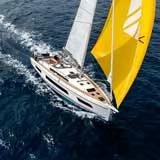
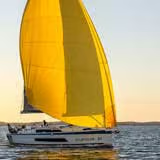
The term "leeward" (pronounced LEW-erd or LEE-wərd) describes the direction downwind from a given point of reference. As defined in Wikipedia, leeward is the side or direction towards which the wind is blowing, serving as the opposite of windward.
In seamanship, a clear distinction must be made between the leeward side of a vessel and a leeward shore (commonly called a lee shore). A yacht’s leeward side (or lee side) is the side opposite to where the wind originates; as the boat heels under sail, this becomes the lower side. Conversely, a leeward shore is land positioned downwind of the boat. While the lee side of a hull offers shelter from wind and spray, a lee shore presents a grave hazard to navigation because wind and sea state continuously drive the vessel toward shallow water or rocks.
Leeward positioning also governs right-of-way under Rule 12 of the International Regulations for Preventing Collisions at Sea (COLREGs). When two sailing vessels have the wind on the same side, the vessel which is to windward must keep out of the way of the vessel which is to leeward.
Executing basic maneuvers such as tacking and gybing requires smooth control of sails as they swing across the leeward side. To counter leeway—the sideways drift toward leeward caused by wind pressure—modern hulls rely heavily on effective sailboat keels to provide hydrodynamic lift and directional stability.
Quick answers
What is Leeward?
The direction downwind from a reference point, or the side of a vessel sheltered from the wind.
What is Leeward used for on a yacht?
Do not confuse the leeward side of a vessel (sheltered side) with a leeward shore (a dangerous shoreline located downwind of the vessel).
What topics are related to Leeward?
Sources and verification
- Navi.training: GPS, AIS та радар. - «Три ока» вашої яхти – чи знаєте ви різницю?
- Navi.training: Как работает GPS, и роль электронной навигации в мире яхтинга
- Navi.training: Як працює GPS та роль електронної навігації у світі яхтингу
- Navi.training: Компас на яхті: Як користуватися морським компасом і для чого він потрібен яхтсменам?
- Navi.training: Essential Sailing Maneuvers for Beginners: Tacking and Gybing in Simple Terms
- Navi.training: Types of Sailboat Keels: How to Choose the Right One?
- Wikipedia: Windward and leeward · CC BY-SA 4.0 / GFDL

 14 min to read