Close-hauled is the point of sail in which a sailboat travels as close to the direction of the wind as aerodynamics allow. Typically, this angle ranges between 30° and 45° relative to the apparent wind (and approximately 45° to the true wind), depending on the yacht's rig efficiency and hull design. To maintain this course, sails are sheeted in flat toward the centerline of the vessel.
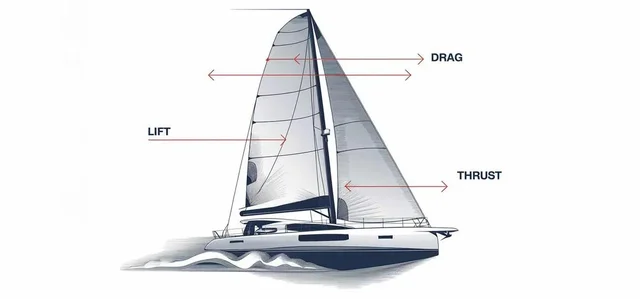
Understanding how a sail works on this point of sail reveals that the sail operates primarily as an asymmetrical airfoil, creating aerodynamic lift perpendicular to its surface. Steering too close into the wind causes the sails to luff and forces the boat into the no-go zone—an arc of roughly 45° on either side of the true wind where propulsion ceases. Conversely, bearing off slightly transitions the vessel to a close reach (roughly 50°–70° off the wind), yielding higher speed but less progress upwind.
Mastering the close-hauled course is essential for beating (tacking back and forth to reach an upwind destination). Performing precise upwind turns requires executing smooth tacking maneuvers. As noted in Wikipedia references on points of sail, close-hauled sailing produces maximum side-force and heel angle, requiring the keel or centerboard to generate sufficient hydrodynamic resistance against lateral leeway.
Quick answers
What is Close-hauled?
The point of sail closest to the wind (typically 30°–45° to the apparent wind), where sails are sheeted in tightly to generate aerodynamic lift.
What is Close-hauled used for on a yacht?
Do not confuse 'close-hauled' (the point of sail with tightly trimmed sails) with 'beating' (the tactical process of sailing upwind via multiple tacks) or 'close reach' (a slightly broader upwind angle).
What topics are related to Close-hauled?
Sources and verification
- Navi.training: Курсы относительно ветра в яхтинге: руководство для начинающих
- Navi.training: GPS, AIS та радар. - «Три ока» вашої яхти – чи знаєте ви різницю?
- Navi.training: Курси щодо вітру в яхтингу: керівництво для початківців
- Navi.training: Як працює GPS та роль електронної навігації у світі яхтингу
- Navi.training: Essential Sailing Maneuvers for Beginners: Tacking and Gybing in Simple Terms
- Navi.training: How a sail works on a yacht: classic and modern explanation
- Wikipedia: Point of sail · CC BY-SA 4.0 / GFDL

 14 min to read