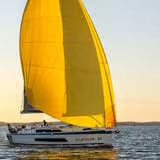
Running downwind is a point of sail in which the true wind blows directly or nearly directly from behind the vessel, aligned at approximately 180° (170°–190°) relative to the bow. As described in Wikipedia's overview on points of sail, a sailboat on a run relies primarily on drag rather than aerodynamic lift to generate forward thrust, with the sails acting much like a parachute.
Understanding courses relative to the wind in yachting is essential for efficient sail trimming. When running downwind, the mainsail is eased out almost perpendicular to the centerline, while the foresail is often set on the opposite side in a "goose-winged" (or wing-and-wing) configuration, or replaced by a spinnaker. The primary practical hazard of running downwind is an accidental or uncontrolled gybe, caused by sudden wind oscillations or steering errors that force the boom to swing violently across the deck. To mitigate this risk, crews routinely rig a boom preventer. Practitioners must distinguish between "running" as a steady state point of sail and the act of executing a gybe maneuver. Mastering these concepts is fundamental alongside practicing essential sailing maneuvers for beginners to maintain safety while sailing off the wind.
Quick answers
What is Running Downwind?
A point of sail where a vessel travels in the same direction as the true wind, at an angle of approximately 180° (typically between 170° and 190°).
What is Running Downwind used for on a yacht?
"Running downwind" (or simply "running") denotes a point of sail. It should not be confused with the maneuver of gybing (jibing), which is the turn during which the stern crosses the wind.
What topics are related to Running Downwind?
Sources and verification
- Navi.training: Курсы относительно ветра в яхтинге: руководство для начинающих
- Navi.training: GPS, AIS та радар. - «Три ока» вашої яхти – чи знаєте ви різницю?
- Navi.training: Курси щодо вітру в яхтингу: керівництво для початківців
- Navi.training: Як працює GPS та роль електронної навігації у світі яхтингу
- Navi.training: Essential Sailing Maneuvers for Beginners: Tacking and Gybing in Simple Terms
- Navi.training: Courses relative to the wind in yachting: a beginner's guide
- Wikipedia: Point of sail · CC BY-SA 4.0 / GFDL

 14 min to read