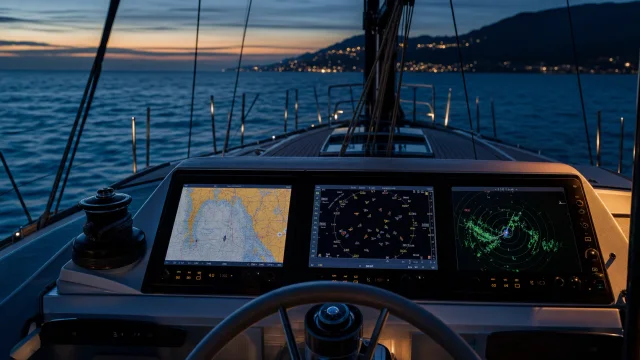
A marine radar (Radio Detection and Ranging) is an active electronic navigation system used to detect surface vessels, landmasses, and weather fronts regardless of visibility. Unlike passive receivers or collision-avoidance equipment linked to how GPS works, radar emits its own electromagnetic pulses and measures the echo delay and angle of arrival to calculate target distance and bearing.
On recreational sailing craft, compact radome antennas operating in the X-band (9.3–9.5 GHz, ~3 cm wavelength) are standard. According to Wikipedia, a sailing mast is a vertical spar designed to carry sails as well as elevated navigational equipment such as radar scanners. The scanner's height above the waterline directly governs the radar horizon; an antenna mounted at 4 meters (13.1 ft) provides a theoretical radar horizon of approximately 4.4 nautical miles (NM) for a surface-level target.
Horizontal beamwidth for standard yacht radomes ranges from 3.5° to 6°, defining the radar's bearing resolution. Skippers must distinguish active radar from passive radar reflectors and AIS broadcasts, which only report cooperative targets. Safe operation requires manual fine-tuning of gain control alongside sea clutter and rain clutter suppression filters to avoid losing small fiberglass or wooden hulls on the display, while keeping heading alignment tied to a marine compass.
Quick answers
What is Marine Radar?
An active radio detection system emitting microwave pulses to measure range and bearing to targets for collision avoidance and navigation in poor visibility.
What is Marine Radar used for on a yacht?
Refers specifically to active microwave radar systems. Do not confuse with passive radar reflectors or Automatic Identification System (AIS) transponders.
What topics are related to Marine Radar?
Electronic Navigation, AIS, Depth sounder, GPS (Global Positioning System)
Sources and verification
- Navi.training: GPS, AIS та радар. - «Три ока» вашої яхти – чи знаєте ви різницю?
- Navi.training: Как работает GPS, и роль электронной навигации в мире яхтинга
- Navi.training: Як працює GPS та роль електронної навігації у світі яхтингу
- Navi.training: Компас на яхті: Як користуватися морським компасом і для чого він потрібен яхтсменам?
- Navi.training: How GPS Works and the Role of Electronic Navigation in the World of Sailing
- Navi.training: The Compass on a Sailboat: How to Use a Marine Compass and Why Sailors Need It
- Wikipedia: Mast (sailing) · CC BY-SA 4.0 / GFDL
 21 min to read