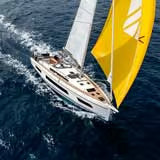
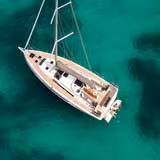
In sailing, a tack describes the position of a vessel relative to the direction from which the wind blows, as well as the fundamental maneuver used to change that orientation. When the wind crosses the starboard (right) side of the vessel first, the yacht is on a starboard tack. Conversely, if the wind strikes the port (left) side first, the yacht is on a port tack. Under the International Regulations for Preventing Collisions at Sea (COLREGs Rule 12), a vessel on a starboard tack holds the right-of-way over a vessel on a port tack.
A tack also refers to the tactical maneuver, often termed coming about, where the bow of the boat turns through the wind eye (an angle of 0° to the true wind). Most modern fore-and-aft rigged sailing yachts cannot sail directly into the wind and maintain an effective no-sail zone of approximately 80° to 90° centered on the wind direction. To travel toward a destination located within this dead zone, the crew must perform a series of zig-zag legs called beating to windward. Each leg sailed on a single heading between turns is also referred to as a tack. Additionally, in sailmaker terminology, the tack is the lower forward corner of a triangular sail, secured near the deck or boom, where the luff meets the foot. Mastering tacks is essential for both navigation safety and efficient windward routing.
Quick answers
What is Tack?
A tack defines both the orientation of a sailing vessel relative to the wind (port tack or starboard tack) and the maneuver of turning the bow through the wind eye to change sides.
What is Tack used for on a yacht?
Used when describing heading relative to wind ('on starboard tack'), making tactical maneuvers ('tacking into the wind'), or referencing the corner of a sail. Under COLREGs Rule 12, a vessel on starboard tack has right of way over port tack.
What topics are related to Tack?
Sources and verification
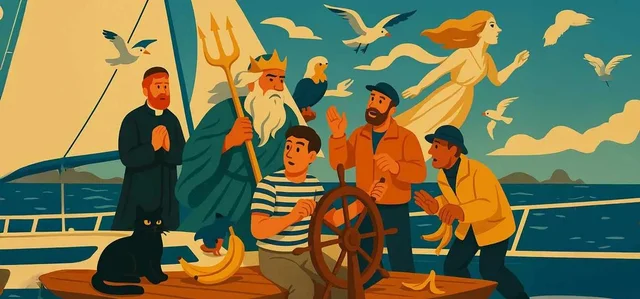
- Navi.training: Sailing Superstitions: From Neptune to the Ban on Bananas On Board
- Navi.training: How GPS Works and the Role of Electronic Navigation in the World of Sailing
- Navi.training: Yacht Rope Handling: Winches and Blocks for Beginners
- Wikipedia: Tacking (sailing) · CC BY-SA 4.0 / GFDL
- Navi.training: GPS, AIS та радар. - «Три ока» вашої яхти – чи знаєте ви різницю?
- Navi.training: Морские суеверия: от Нептуна до запрета на бананы на борту
- Navi.training: Как работает GPS, и роль электронной навигации в мире яхтинга
- Wikipedia: Парусное судно · CC BY-SA 4.0 / GFDL
- Navi.training: Морські забобони: від Нептуна до заборони бананів на борту
- Navi.training: Як працює GPS та роль електронної навігації у світі яхтингу
- Navi.training: Компас на яхті: Як користуватися морським компасом і для чого він потрібен яхтсменам?
- Wikipedia: Галс (значення) · CC BY-SA 4.0 / GFDL
 32 min to read