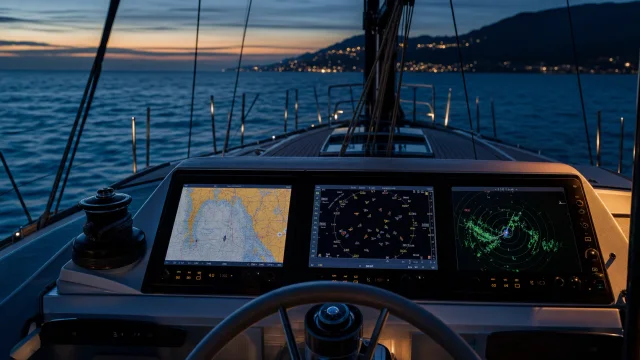
Heading defines the instantaneous orientation of a vessel's longitudinal axis relative to North, expressed in degrees from 000° to 359°. In marine navigation, it is crucial to distinguish heading from Course Over Ground (COG). While heading indicates where the boat's bow is pointing, COG represents the actual track of the vessel across the seabed, influenced by current, tidal streams, and leeway caused by wind.
Heading can be expressed relative to three different references: True North (True Heading), Magnetic North (Magnetic Heading), and Compass North (Compass Heading). True Heading aligns with geographic meridians. Magnetic Heading accounts for magnetic variation (the angular difference between true and magnetic norths), while Compass Heading incorporates both variation and local magnetic interference on board, known as deviation. Navigators must systematically apply variation and deviation corrections when converting between these values.
While modern satellite receivers determine COG, an onboard magnetic or electronic compass is essential to measure true heading. Understanding this difference is vital when navigating challenging regions, such as when planning yachting in Corsica. As referenced in navigation standards documented on Wikipedia, differentiating between heading and course over ground is essential for collision avoidance under COLREGs and for calculating drift corrections. Proper mastery of marine compass operation ensures accurate dead reckoning and safe vessel control in all conditions.
Quick answers
What is Heading?
Heading is the direction in which the longitudinal axis (bow) of a vessel is pointed at any given moment, measured in degrees from 000° to 359° clockwise from North.
What is Heading used for on a yacht?
Do not confuse Heading (orientation of the vessel's bow) with COG (actual track over the seabed) or Bearing (direction to a target object). Always convert between Compass, Magnetic, and True headings by applying deviation and variation.
What topics are related to Heading?
Sources and verification
- Navi.training: GPS, AIS та радар. - «Три ока» вашої яхти – чи знаєте ви різницю?
- Navi.training: Как работает GPS, и роль электронной навигации в мире яхтинга
- Navi.training: Як працює GPS та роль електронної навігації у світі яхтингу
- Navi.training: Компас на яхті: Як користуватися морським компасом і для чого він потрібен яхтсменам?
- Navi.training: The Compass on a Sailboat: How to Use a Marine Compass and Why Sailors Need It
- Navi.training: Yachting in Corsica: the best routes, locations and vacation secrets
- Wikipedia: Apparent wind · CC BY-SA 4.0 / GFDL

 42 min to read